Last updated: 28/05/2007  

PAGE 1 | PAGE 2 | PAGE 3 | PAGE 4 (TT299)


The two tombs of Inerkhau , (TT359 and TT299).
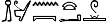
The study of Inerkhau's circumstances proves to be fascinating, because this character, important in his position among craftsmen but not belonging to the Egyptian aristocracy, knew how to find the means to construct for himself not only one but two tombs.

The tombs of this last period of occupation of the site of Deir el-Medina are rarely decorated. Whether it was a lack of time and suitable finances, lack of qualified personnel, uncertainty and political unrest or increasing poverty of the monarchy engendering that of the workers? It seems that the progressive decadence slowed down, then almost stopped the artistic development of painters and their product.
Only the favoured, such as the chief of works Inerkhau and the foreman Hay (tomb TT267), a contemporary of Ramesses IX, seem to have had enough fortune or skill, enough authority and connections to make for themselves beautifully decorated tombs with polychromatic frescos. The rest of the corporation of craftsmen appear to have been content with chapels and chambers merely covered in a plain white-wash covering.
It was also the period of socially unrest, the period situated between the end of the reign of Ramesses III and the beginning of that of Ramesses IV, the period well known for the first strikes known in history, motivated by the non payment of the wages by a Pharaonic administration at a time strangled by the lack of resources in the treasury and also for being extensively corrupt.

The first tomb of Inerkhau is reduced today to its chamber and bears the number TT359: it is one of the rare tombs that the Supreme Council of Antiquities hasn't (yet) closed. It also included a forecourt, which proves to be complex as will be seen, and a decorated chapel of which nothing now remains.

Inerkhau's second tomb is TT299 and it was probably this one which was intended for Inerkhau himself, TT359 probably being meant for the the use of his family. What remains of this will be examined within these pages thanks to the reports of Bernard Bruyère's excavations. These reports are exceptional and are first-hand documents of the study of both monuments

 INERKHAU AND HIS FAMILY 

The name Inerkhau signifies literally: "Onuris appears" (Onuris was a Greek inflection of the name of the god Iny-Hor); he was the son of Hay and his wife was named Wabet.
He belonged to an old family of "foremen", being the leaders of the craftsmen of Deir el-Medina working in the "Set-Ma'at" (= the place of truth, the Valley of the Kings). These workers and craftsmen were placed in charge of the digging and the decoration of the tombs in the Valley of the Kings and in that of the Queens.

Inerkhau was in particular responsible for the work carried out in the royal tombs, the prime directive of the institution which he directed, as his titles show :
"Foreman in the Place of Truth in the west of Thebes";
"Director of the works of the Lord of the Two Lands"

In his tomb, Inerkhau is accompanied by its wife Wab(et) ("the Pure") and many children. Wabet carries the commonplace title of "Mistress of the House", but also of "Chantress of Amon", which shows that she had a function in the temple of Karnak.

The genealogical data that exists (Bruyère) appears confusing, but it seems that :
• Huy, the owner of TT361, was the father of Qaha. Huy is the one who painted the chamber of his great-grandson Inerkhau.
• Qaha was the grandfather of Inerkhau.
- This is the same Qaha who is owner of the chapel TT360, with a preceding courtyard and additional courtyard with the peristyle (pillared porch) decorated with stelae at its rear (see below).
• Hay was the father of Inerkhau. His name is mentioned in the two tombs TT359 and TT299. In an inexplicable manner, he doesn't possess a clear funerary monument in this group.
• Inerkhau (son of Hay, grandson of Qaha and great-grandson of Huy), husband of Wabet, who is owner of these two tombs which are the basis of these three related pages.

 COURTYARDS OF TOMBS 359, 360 AND 361 

It is indeed necessary to consider this domestic group which unites Inerkhau to his two forebears.
It represents a vast terrace of 28m from north to south and 14m at its greatest depth (east-west). It is elevated artificially with the help of embankments and thus raised by about 3 to 4 metres above the level of the village of Deir el-Medina. It was surrounded by thick walls and decorated with pyramids, made from thick stone blocks bound by a lime mortar and then coated with a white plaster.

top viewside and front viewsreconstruction
(C. Robichon)

The chapel (TT360) of Qaha only partially survived at the time of its discovery, because the south part had collapsed in an adjacent chamber underneath and only 0.80m of the north walls and the shrine were even present on top. Its measurements are estimated to have been 5.30m along the facade and 3.20m in depth. The shrine of the chapel was surmounted by a pyramid with sides of 5m and 7m in height.
The burial chamber of Qaha was decorated in a much more interesting manner than that of Inerkhau: this was the work of a real master from the time of Ramesses II and the result is close to that of the famous tomb of Ipuy, TT217. It cannot presently be detailed here, on this web-site.
The pyramid of Huy stood to the right of the one of his son Qaha; it measured 4m along its base sides and had a height of 5m. It surmounted a room of 2.30m in depth by 1.40m in width.

 The north courtyard 
To the north (on the right on the plan), Qaha extended the courtyard which was in front of the chapel of Huy on a old layer of ashes and "sebakh" mingled with straw dating from an even older time. It had originally been the location of a previous funerary monument (and independent of this chapel) and which now formed of a courtyard of 8.25m x 5m and a peristyle as wide as the courtyard and 2.65m deep with three 0.70m wide full pillars and two half pillars.

The courtyard with the peristyle, of Qaha, was surrounded by walls to the north and south with a communicating door towards the courtyard of Huy. To the east, a pylon wall, more elevated and thicker, framed the main entry, which explains the projection of this wall in relation to those of the other two, because the final stage of the mausoleum of Qaha included the fusion, into a single unit: the three courtyards and facades of the three chapels.

The rear wall of the peristyle was decorated with two large stelae of engraved limestone and it was painted and pierced by two doors
• The one at the south (left) opens up on to a small room of 1.60m x 1.80m, which seems to have been a chapel and of which the brick walls were probably decorated with frescos or bas-reliefs, but which no longer exists.
• The one to the north (right) opens up on to a staircase which first went up towards the west. It then turned through 90º and proceeded north to exit the monument outside on to the path of the necropolis. This went from the village toward the Valleys of the Kings and Queens. It thus passed to the foot of the terrace courtyard of the funerary concession of Sennedjem TT 1.

Between the two doors and behind the stelae of Qaha one would have expected to find a central chapel having been the main goal of the construction of the whole monument. In reality, this space was, at the time of the discovery, just an empty space in the middle of which penetrates a brick-lined funerary well descending to the burial chamber (TT359) of Inerkhau.

Why did Inerkhau possess two tombs ?
The use of family tombs at Deir el-Medina goes back to the end of the 18th Dynasty, but by this time encounters a problem of space: the hill is not expandable and the considerable growth of some families caused a difficulty for the location for new mummies in the lower limits, which was restricted because of human habitation.

One would think that the accession to an important function such as the one of chief of works, if it didn't give the right to a special mausoleum, provided for the vanity of the newly elected sufficient reason to assume this prerogative and that, in fact, all chief of works hastened after their nomination to acquire a second tomb.

For these motives, Inerkhau, a member of a large family which already included several chiefs of works, would first have dug and decorated the burial chamber N°.359 to the north of the tomb of his forebears Huy and Qaha, would have then, after his hierarchical elevation, created for his personal use the large tomb complex TT299. Meanwhile, the grouping together of the three tombs 359-360-361 was destined for the other family members.
Bruyère recovered the charred remains of the wooded case of Wab(et), the wife of Inerkhau, in the burial chamber of his ancestor Huy (TT360).

Why did Qaha have a chapel separated from his courtyard with the peristyle ?
A religious principle which always places Horus to the left of his father Osiris exists when this couple of gods faced the rising sun, and it also imposes on mortals to place the son's funerary chapel to the left of that of the father, when viewed facing east.
At Deir el-Medina, striving for this formation was constant and often achieved only at the cost of modifying the layout conceived by previous generations.
It is possible that Qaha, who already had his chapel N°.360 to the south (that is to the right of pyramid N°.361 of his father Huy), when he wanted to conform to the rules of divine and funerary precedence, created a false facade for a chapel to the left of his father's tomb. The peristyle decorated with stelae, which didn't open up on to anything but did create a majestic porch at the rear of a vast courtyard.

This hypothesis necessarily implies that the place was already occupied by Inerkhau and that (with the agreement of his son), Qaha would have removed all superstructures of his descendant's tomb and thus providing him with an access (only) to the burial chamber behind the peristyle.
This would thus resolve this ritual problem according to the customs of the community, Qaha and Inerkhau both being on the left of their ancestor Huy.
The disappearance of his actual chapel could be an additional prime reason for driving Inerkhau to make for himself a new separate tomb, TT299.

 THE BURIAL CHAMBER N°.359 : ARCHITECTURE 

The excavation of the subterranean region of the peristyle found, in the north-east east corner of TT361, a previous well shaft of the 18th Dynasty, with a depth of 4.85m, which accessed a long and low burial chamber to the west. This connected by a breach in its western side with the bottom part of the well shaft of TT359, exiting opposite the door of Inerkhau's first chamber (chamber F).

However the real access to Inerkhau's burial chamber was by the vertical shaft of about 4.50m depth located in the chamber behind Qaha's peristyle. This lead by a downwards sloping corridor, in a south west direction, to a small arched corridor joining it at a right angle, which then emerged into the first of Inerkhau's underground chambers (chamber F).

A comparison of the present state of the monument with the plates of Richard Lepsius (middle 19th century) shows everything that has since been lost.
The first room (chamber F), oriented south-west/north-east, is 4.70m long by 2.05m wide. The summit of its arched ceiling reaches a height of 2m. Into the south wall is dug a niche (annexe) which occupies the whole length of the wall. In the north-west corner, is a descent of four steps permitting access to a second room (chamber G). Although not at right-angles to chamber F, this chamber is still not aligned exactly south to north, more south-south-east/north-north-west. Its dimensions are: length 4.85m and width 2.30m. Its arched ceiling reaches a height of 2.17m.
The cross-sectional view better shows the underground arrangement.

Dug into the rock, the two rooms constituting the burial chamber of Inerkhau were however faced with mud bricks, these were then covered with a coating of silt mixed with a yellow pulverised powder which settles after the rains and which was used as binder. This was then whitewashed with a top coat of plaster. Finally the representations were applied in a mixture of colours on the typical yellow background of the time.

 THE DECORATION - IN GENERAL 

The monument is characterised by several original details: good quality of execution of paintings, painted ceilings of the first chamber, seldom found funerary vignettes, literary or religious texts, and an original provision of decorations (primarily extracted from the Book of the Dead), which can be coherently analysed through the Egyptian concept of the beyond at the end of the New Kingdom.

The fashion to decorate the tombs at Deir el-Medina started under the reign of Sety I and lasted during all of the 19th Dynasty, to reach its greatest intensity under the reign of Ramesses II, which is logical considering its length.
It survived during the 20th Dynasty, at least until the reign of Ramesses IV, and it maybe ceased with the last of the Ramessides, we do not have evidence of all cases of it for this time.

It is necessary to remember that this is a burial chamber, therefore the underground part of the tomb, whose access was forbidden after funeral ceremony. Its decor was destined solely for the deceased and only includes scenes of funerary concerns. No element of the social life of the deceased is represented here: they were represented in the surface chapel, but in the case of Inerkhau this has disappeared.

The distribution of paintings form a certain coherence which is first divided into a "vertical" distribution of scenes.

The lower register is occupied by the representations of the rituals accomplished by the family of the deceased.
The upper registers contain vignettes extracted of the funerary books.
The bases of the walls of the two rooms are decorated with the motif of a surrounding wall with castlements, all on a white background, This, together with two upper coloured horizontal bands, delimits the space dedicated to religious and artistic decoration of the tomb.

The decor of the first chamber is centred around the arrival of the deceased in the world of the beyond. In this, Inerkhau's wife Wabet plays an important role. This role is much more discreet in the second chamber which especially represents life in the beyond.

It seems that the decor has been created so that the walls situated on the right, when heading from the entry of the first chamber towards the rear of the second, favour the rituals of welcome and transformation until the moment where Inerkhau presents himself in front of Osiris and Ptah at the rear of the second chamber.
The opposite walls are inscribed from the rear of the second chamber up to the western wall of the first, so that the transformation which resulted in a new life, are outwardly manifested in the representations of the south-westerly wall of chamber F.
A cyclic movement results from this, in an anticlockwise direction, leading the deceased from the simple mortal stage to a complete assimilation into the house of imak (= privileged, blissful, favoured...) in the necropolis and in the beyond.

It should be noted that there is a total absence at this time of evocation of funeral ceremony in the chamber: no funerary procession, no scene of lamenting, no funeral banquet...

You can consult the set of the texts of the tomb [§108] produced by Richard Lepsius in format, (currently German only).

 THE ENTRANCE 

The entry doorway from outside of the first chamber, which measured 1.20m in height and 0.72m in width, was closed by a recessed wooden door in a painted door frame of engraved chalky stone. The lintel has disappeared, but the vertical doorposts, of which a part still remained in place on the south side, have been recovered almost entirely. They carry two engraved hieroglyph columns painted in blue on yellow ochre base. The south doorpost carries a supplication to the cobra goddess Meretseger, protector of the Theban summit and therefore of the community of the craftsmen, as well as to Ptah-Sokar-Osiris. While on the north doorpost the two supplications are to Osiris and Anubis.

 CHAMBER F 


View of the entrance
and south-west wall
The internal side of the door measures only 1.47m in height and leads to an ogival corridor, 0.95m long, painted white.
Under the traditional protectors of the necropolis and their workers, queen Ahmes-Nefertari and the Pharaoh Amenhotep I (as divinities), Inerkhau and his wife are received into the necropolis by the goddess Hathor.
Indeed, immediately to left on entering (the south-westerly wall of the passage), in the upper register we find Inerkhau and his wife knelt in worship in front of what remains of the Hathor cow, who leaves the mountain of the West. The goddess is going to receive them within herself to allow them, at the end of a new mystical gestation, to reappear out of the mountain which served to bury them (Bruyère pl VII).

Accompanied by one of his sons, Inerkhau faces the gods Ptah and Osiris, whose representations reflect those of the sovereign divinities on the opposite wall.
The floor of the chamber was packed down and stuccoed and at the time of opening was covered with a thick layer of fragments of funerary furniture and with the remains of mummies.

 The ceilings 

The first pillagers had entered the tomb through the arched ceiling of the first chamber, from the bottom of the well shaft (Bruyère pl V). The ceiling of this first chamber had been executed particularly well and impresses the visitor by its beauty and originality on immediately entering the room.
The arch is divided and bordered into eight panels by three longitudinal and five transverse bands covered with hieroglyphic inscriptions. The artist wanted to imitate by this device, and by the motifs which fill the rectangular panels, the carpets or mats which acted as roofing and cabin canopies which sheltered the high ranking peoples on the boats which travelled the Nile.


All panels are delimited at the edge by a red and white band. Inside, they are surrounded by a frieze of blue and green rudimentary khekeru, interrupted in the middle of every line by a short group of yellow and red khakeru.
The motifs are varied, with images of yellow/gold scrolls framing the heads of livestock wearing a solar disk between the horns (view 47). It should be remembered that these representations of bovines already existed in some mastabas of the Old Kingdom. This scroll motif is treated distinctly here according to a Cretian inspiration which expresses the shape of surging waves, and not with Hathoric origins as one sometimes reads.
Other motifs combine the rosettes and the waves with a streamer where are inscribed the names of the deceased. Others imitate a vine with leaves and clusters or make alternate alignments of rosettes and scrolls or present small flowers in a rectangle of multicoloured rows.
All texts include an invocation to the god Ra in his Amon-Ra form, Ra-Horakhty or Harmakis (the Greek form of the Egyptian Hor-em-akhet, Horus-of-the-Horizon; in memory of the most famous representation of this last one is the great sphinx of Giza). The central band presents an offering formula of the traditional type "hetep-di-nesu" ("an offering which the King gives") where the deceased invokes Amon-Ra. The first transverse band, east side, is a formula of worship to Ra for his daily rising in the Duplicate Horizon, whilst on the west side, Ra is invoked at sunset to descend into the Duplicate Horizon.

 The south-west wall 

• This wall is complete at the bottom part to a height of 0.80m, above this it penetrates 0.95m into the rear of the wall, with a ceiling forming a half arch (highest at the front and curving downwards at the back (see view 5bis). The front originally had a tympanum of brickwork supported by a wooden frame, the left and right vertical supports protruded sideways into the opening by 0.15m and internally by 0.40m and a vertical beam of wood at the centre. These supported a horizontal beam which was tied into the side walls.
The tympanum was painted with a representation of the goddess Isis which would have had the same form as the surviving portrayal of Nephthys on the tympanum of the opposite wall.
The theft of the wooden framing resulted in the collapse of the tympanum. Today the end uprights have been replaced in mud brick (view 54). The tympanum itself has not been replaced.
What could have been the use of this unusual niche? Could it have been used for the placing of offerings on the day of funeral ceremony? Is it possible that the coffin of Wabet was placed here after her death?

• The lower part of the wall shows two superimposed images of the deceased and his wife on their knees paying homage to those who receive them in the underworld. On one side is the goddess Hathor, in the form as a cow, leaving from the mountain of the West. On the other side are seven mummiform divinities, crouching and holding knives, as the guards of doors of the underworld, who are there to both try them and to protect them when they will have been recognised as pure (view 7, Bruyère pl VII).

• The niche contains a representation of Inerkhau, followed of his wife Wabet, both kneeling, their arms raised forward in a sign of worship.
The eyes of the two deceased are much to big. A stubble growth of a beard is noticeable on his chin and cheek. This is a rare detail in Theban painting, which could be interpreted as a sign of mourning.
His right arm ends with a left hand, as does that of his wife (view 46 and view 62). This substitution is frequent in Egyptian craftsmanship and results from the will of the artists to represent the elements of the human body in a way immediately identifiable to the spectator: A right hand (whose thumb would have been hidden therefore) would probably not have answered the proposed identification.

• The rear (left-hand end) of the niche, in a south-westerly recess, includes a reclining jackal on a mastaba, wearing a red ribbon around its neck, holding the sekhem-sceptre between its front paws and the flagellum between its rear paws (view 5bis and view 64). It represents an avatar of Anubis watching over the necropolis.

 The south-east wall 

On the whole height of the wall is an exceptional scene alas mostly lost today. Fortunately we possess the copy which Lepsius created and it allows us to reconstruct the wall. It is dedicated entirely to the great cult of kings and queens buried in Thebes - and therefore in Osiris-form - by Inerkhau, who here plays the role of funerary sem-priest. On the opposite wall will be found a nearly identical celebration of the cult of Osiris. The two scenes therefore reflect each other.


The deceased and his wife present themselves facing twenty royal divinities, distributed on two registers, in front of which Inerkhau carries out the fumigation with the help of a long censer (view 5 and view 58). He is clothed in the panther skin of the sem-priests, a long fringed white tunic and he is followed by his wife, who wears a long dress. The couple occupy the height of the two registers.

The names of the characters are sometimes difficult to recreate (damage, mistakes by the scribe and homonyms).
• On the top row are three kings and seven queens. The first two are Amenophis I and Ahmose, respectively second and first king of the 18th Dynasty. The last character is the prince Sa-pa-iry who is distinguishable by the absence of a cartouche and uraeus, he has the lock of hair worn by royal children and a short beard.

• The lower row consists of seven kings, a prince and queen Ahmes-Nefertari, represented with black flesh (although she was probably not Nubian): together with her son, Amenhotep I, she was patron of the Theban necropolis and its craftsmen, she is as black as the silt of the Nile - and the mummy - a promise of regeneration. She is followed by Men-pehety-Ra (Ramesses I, XIXth Dynasty) then Neb-hepet-Ra (Montuhotep, XIth Dynasty). The prince wears a wig different from that of the kings, his left hand holds the stem of a lotus whose flower opens up in front of his face while the right hand placed on his thigh holds an Ankh sign.

• The royal characters are all dressed the same way, with an Osirian white shroud and carrying the attributes of royalty: uraeus on the forehead, heqa-sceptre and flagellum in their hands. They have a non hooked long beard and have a large usekh-necklace around the neck. Finally, they have the attitude and the costume of Sokaris. They are only identified by their names in a cartouche.
It is the same for the queens, all wearing the ancient symbol of the vulture headdress, an attribute of the goddesses and queens since the 4th Dynasty. They wear the diadem headdress of the Isis-mothers, the usekh-necklace, the belt with dangling ends and they represent an image of Hathor.

• All these characters are seated on low square thrones which also rest on a pedestal, which indicates that these are not the characters themselves, but their statuaries. The one of the queen Ahmes-Nefertari could have been covered with asphalt, new possible explanation for her black colour (which doesn't exclude any others).
From this, can be interpreted that this is a list of the recipients of a "temple of millions of years" still functioning at the time of Inerkhau (JL Chappaz).

• At the rear of this scene, on the bottom row, is found a very interesting and exceptional representation: the painter Huy, ancestor of Inerkhau, is shown squatting on a platform, reed and palette in his hands. Huy is therefore probably the author of the decoration of the tombs 359 and 360. Here, is probably one of the exceptional "signed" decorations of the Theban tombs. Today only the lower part of his body and feet survive, showing the attitude of this unusual subject (view 9bis).

 The north-west wall 

The wall is divided into two registers, as can be seen from the two angled view : toward the left (view 56) and toward the right (view 60). These are separated by the stylised matting on which the upper scenes rest.
In the lower scenes, the deceased couple receive homage from their close relatives in the setting of the funeral cult (view 6). The couple appear in three sub-scenes, each time seated on elegant chairs whose feet have the shape of lion paws, receiving flowers and necklaces; purifications by means of libations and fumigations; finally foods are dedicated them.

The upper register
With the exception of the final scene, which extends over the corner of the wall, the deceased couple are represented with their backs towards the rear of the chamber, which means turned facing out of the tomb.

On the left, Inerkhau is represented seated alone on a chair (view 7). It takes place in a light barque of which the prow and the stern have the shape of a lotus bloom. On the hull, either side of the seat, is painted an udjet-eye, a sign of bodily integrity and a promise of health. A pair of oars and their supports, all of whichfinished in the head of falcon, indicate the direction of navigation.
The deceased, clothed in the civil costume of the 19th Dynasty, wears on his neck a multicoloured pearl necklace and a garland of flowers and natural foliage. A headband decorates his shortish length wig. He has a short, square beard.
The most interesting detail of the scene is his gesture: he holds his arms open wide to stretch out a large white piece of material behind his shoulders, a rare image for which Egyptology hardly proposes a satisfactory explanation (view 35 and view 33).

[I have a proposal. This image reminded me of a representation from the anonymous tomb TT175, published by Lise Manniche. There, two crafts can be seen, in connection with the ritual pilgrimage to Abydos.
At the end the return trip, the young sailor at the front of the boat makes precisely the same gesture as that of Inerkhau. I suggest than it represents a visual signal to indicate to the people on the shore that the boat is ready to tie-up. This signal can also indicate an operational manoeuver to other boats, thus avoiding collisions. /T.B.]


The following scene, damaged by an attempt to remove the text, represents the deceased seated on a chair with his feet relaxing on a cushion (view 31). He holds a sekhem-scepter to his chest and stretches his left hand toward a pedestal holding three sheaves of onions and two lotus bouquets. His civil attire differs only from the previous one by the necklace and the wig. The text which surmounts the pedestal is of a religious nature: the two sisters, Isis and Nephthys, lament the death of Osiris (view 29).

Then, after a long text in 11 columns, is another scene (also damaged by the removal of the faces of the characters and ba-(or soul-)birds originally located in front of their faces. The deceased and his wife, in long white dresses, are seated on chairs with lion's feet. A kiosk made from matting, similar to that under the whole register (view 8 and view 60).
In front of the kiosk is a light pedestal, a table for board games whose upper face is probably decorated in checkerboard design, has on it nine gaming pieces for the game of senet or menhet, consisting of five white, three blue and a red, all of the same tall shape (ball or ring on top of a conical foot) but of different sizes.
Perhaps the inequality of size of the pieces is to show the effect of perspective or is a reflection of the real difference.
The deceased advances his right hand to take a piece, while his wife makes the gesture of imposition by spreading her right hand toward the game.
Nothing remains of the two Ba-birds seen by Lepsius, other than the base of the mastaba on which they were perched, above the gaming board.
The 11 lines of text give the progress of the game in a mythological form.

The extremely large damaged area extends beyond the couple, to almost the end of the register, again probably due to attempted removal of the scenes or text. It has resulted in the disapearence of the procession of parents (and notably the children) who followed the couple, all of whom were turned to face the rear of the chamber.

Lower register
This register is entirely dedicated to the funerary offerings made to the deceased and his wife by the family's members.


North-west wall, lower register

This is connected with the funerary banquet scenes which are seen in other tombs. It provides the pretext for an indispensable genealogical exposition, by the including the offerings to the two deceased by a succession of generations. This is also a magic and inevitable (as the Egyptians knew well) means to mitigate if possible the deficiences of the younger generations.

It is composed of three successive scenes in which the seated couple of Inerkhau and his wife participate in the funerary cult in its different forms.
Viewed from south to north:

1)- Inerkhau, clothed in the civil style of the 19th Dynasty, his head decorated with a headband, his chest is covered with an usekh-necklace and a garland of foliage, he has sandals on his feet which have a hooked tip. The left hand holding the sekhem-sceptre receives the gifts: Aegean perfume vases, garlands of willow leaves and bouquets of lotus, brought by a couple in simpler costumes. The deceased's wife makes the gesture of embrasement and imposition. The recipients of the offerings face to the (theoretical) south and are therefore oriented like Osiris would have been and as they would be on a stela, since the cult of the ancestors elevates mortals to gods.
Notice that in the tomb of Inerkhau there is no representation of the cone of offerings so frequently represented elsewhere, and of which the real or symbolic nature remains under discussion.

2)- Inerkhau and his wife, always in festive dress, are seated in front of a pedestal on which are many persea tree fruits. Inerkhau takes one of these fruits, his wife holds a bird: pigeon or hoopoe.
Three of the men have a shaven head, a naked upper body except for the crossband of white fabric of sacred barque porters, they wear the long and pleated skirt and an usekh-necklace. They make a libation offerings to their parents or the statuaries of them. The first of the three officiants is clothed in the panther skin and uses three vessels while the others only use one vessel and a censer for the fumigation.

3)- The couple, clothed identically to those of the two other scenes, are largely destroyed. They sit in front of a double altar holding round breads, onions and a front leg of an oxen or antelope. A couple advance towards them, the man holding an pitcher and a censer, the woman offering a basket of grapes. Notice a child's legs (in deep red colour) in front of the couple. A piece of the wall, which includes the chest and head, and also those of Inerkhau, has been removed, and is now in the British Museum.

4)- In the damaged area which follows was a scene once seen by Lepsius showing Inerkhau seated in front of a table of offerings and to whom his son made libation.

5)- The accompanying texts reveal the name of the father of Inerkhau and his grandfather, respectively Hay and Qaha. Qaha is the owner of the neighbouring funerary chamber and chapel, TT360. From the text it can be ascertained that one of the sons was also named Inerkhau, nicknamed Aryu.

The north-west corner
At the level of this register is an oblong opening, being the descent toward chamber G. Above, the end of the wall contains a residual image of Inerkhau followed by Wabet. The deceased fortunately remains well preserved, and the artistic creation is of a high quality. He is standing, shaven headed and dressed in a panther shin, turned therefore toward the rear of the chamber, because he presents on two portable altars an offering of roasted ducks to Osiris (view 10bis and view 10ter). Wabet hasn't had the same fortune, her effigy has almost disappeared.
The god Osiris, to whom the couple give homage, was initially on the north-east wall, thus being an extension to the wall just described.

 The north-east wall 

It was certainly originally the most important wall of the first chamber. Today the whole lower and middle part which sheltered Osiris under his dais has disappeared.
The only area which still survives is the top left part of the tympanum, where the goddess Nephthys can still be recognised, with her extended wings, squatting on a frieze of uraei which separated the tympanum of the rest of the wall. Her face is surrounded by two udjat-eyes, symbols of full and whole resurrection. This tympanum was the counterpart or the one originally situated on the wall opposite and which represented Isis.

The wall includes, in the north-east corner, a low arched doorway into chamber H. The outer framing of this doorway was painted white edged with a red band on either side, the central white area included a hieroglyphic text. Only the right-hand side now survives (view 9).

 CHAMBER H 

This rough cut chamber is rather small compared with the previous chamber, although once through its entry it extends to the left to almost the width of chamber F. Its length is similar to its width. It was probably originally destined to receive the ceramic vessels and the baskets of lingerie, and later the coffins of the family's members. It served as a sorting place for the modern pillagers: they had heaped numerous mummies here.

PAGE 1 | PAGE 2 | PAGE 3 | PAGE 4 (TT299)